When I was reading the notes on crystal structure it stated that in example B, the unit cell (also shown below) was a primitive unit cell. This was the case because each of the
four vertices of the square only occupied the lattic by 1/4th. Why is this the case? I would expect the unit cell, as the span of two vectors, to be a set that either contains or does not contain a certain point. What am I missing?
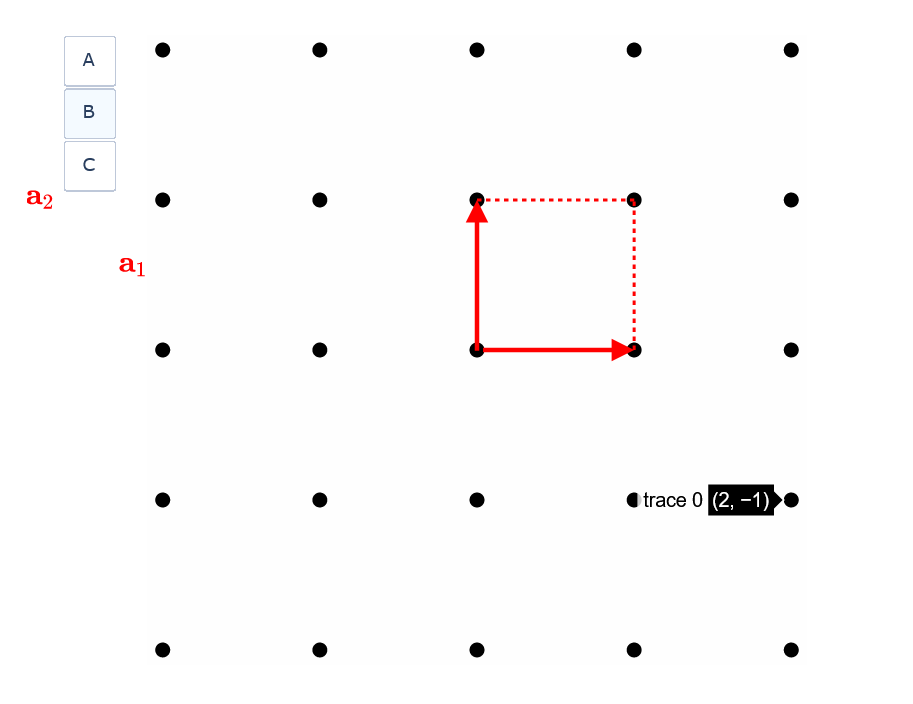
The unit cell you show here has 4 corners. Each corner shares 1 atom with 3 other unit cells, meaning that each corner “gets” 1/4 atom contribution to the unit cell. In total, each unit cell has 1 atom 1=4*1/4.
Thanks, that makes sense. However, I am still a bit confused by the exercise: they consider this unit cell:
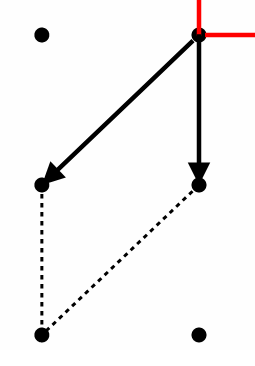
They then say that two points have occupation 1/8th and two have occupation 3/8th.
Why is this the case? Each vertex is part of three other unit cells, so I would expect an occupation of 3/8th for all four points. Is there some kind of rule that forbids “sharing” two different points with the same neighbour?
That is because of the inner angle at each point. In total the contribution must be 1 only, so physically it makes sense. However, how much each corner contributes depends on the unit cell that you have chosen, which is not a problem because this is just for us to describe the problem and it does not have any physical consequences.
I hope this picture is clearer. Here we see that one atom will contribute differently to the different unit cells around it, but its total must be 1, because it is only 1 atom. At the same time, even though each blue angle contributes 1/8 and each green one contributes 3/8, in total they all sum up to 1 per unit cell.
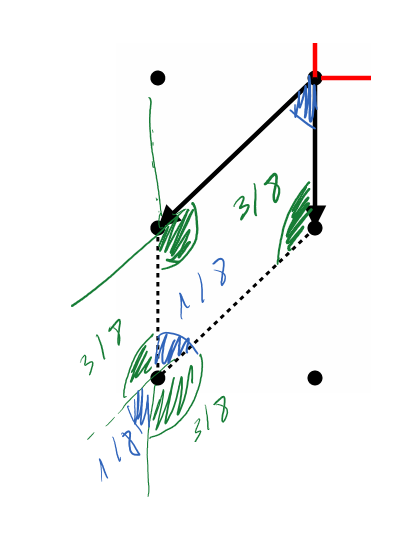
The values 1/8 and 3/8 are those and not others because the lattice is a perfect square and the new lines are diagonals of the squares we see. In a different lattice these values would just be proportional to the inner angle of the polygon, but they would still add up to 1.
You have to look at which fraction of the vertex lies in the current unit cell. The angles are 45 degrees here, so 1/8 of the circle of the bottom vertex lies in the unit cell drawn here.
@MarkVermeulen let us know if you still have questions left!  otherwise please mark one of the answers as the solution
Thanks, I get it now. I have marked a solution