Hi,
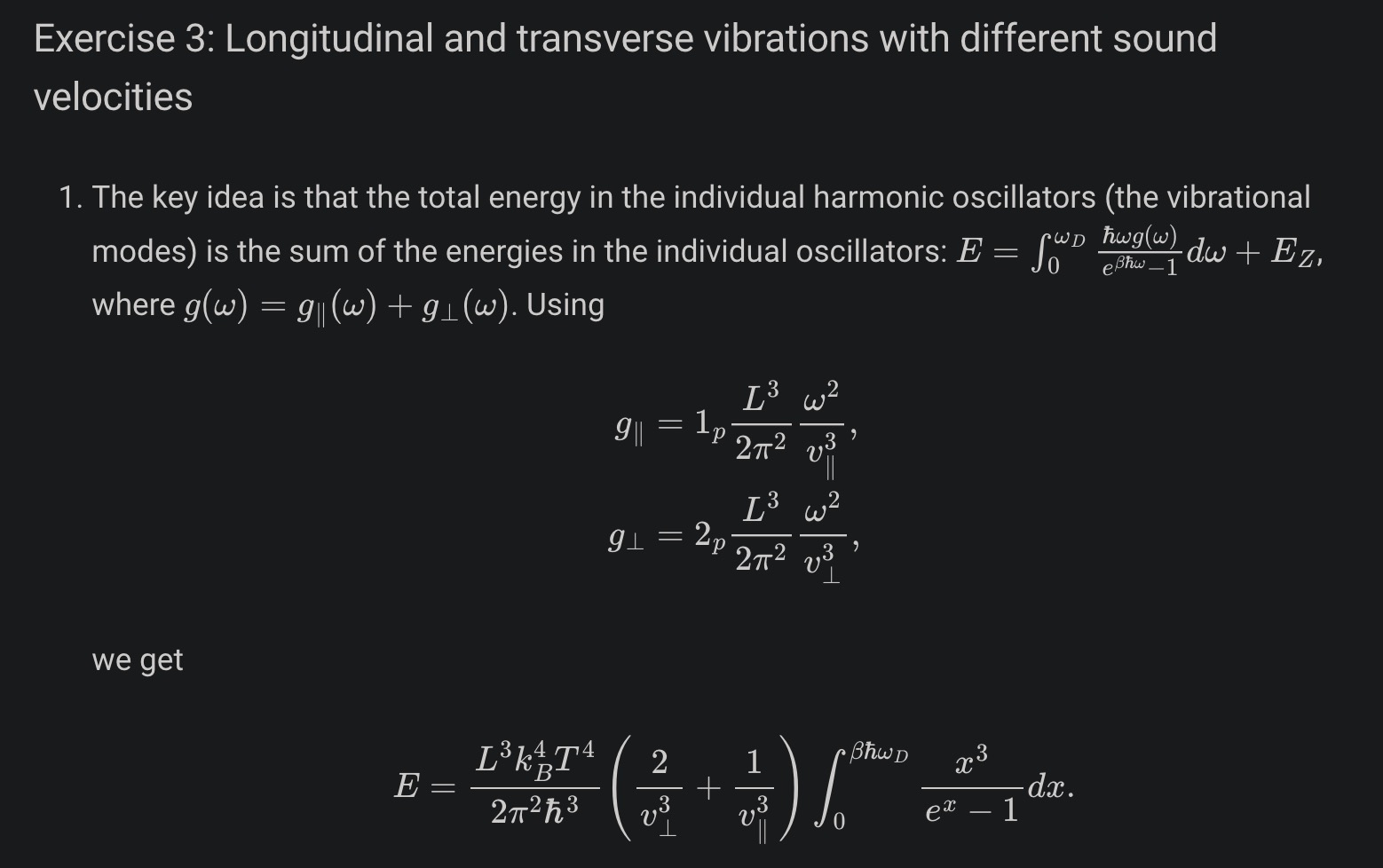
In exercise 3 of the Debye model two different dispersion relations are used, one for longitudinal and one for transverse vibrations. I understand that there are 2 polarizations in the transverse direction and one longitudinal for every wave, but why is only g(\omega) affected by this? (see picture below)
I expect that the energy scaling is affected, and the integrals over \omega also wouldn’t neccesarily stay the same. Could somebody explain to my why only g(\omega) needs to be changed?
Thanks in advance!
Jasper Brinkgreve
You seem to be thinking about the problem in terms of required actions. This is often inefficient because actions follow the logic and the underlying concepts.
I think the most direct way to think about this problem is to compare it with the last exercise of the Einstein model. The contributions of different degrees of freedom add up. That means we have:
- A Debye model with 2 polarizations and v=v_\perp
- A Debye model with 1 polarization and v=v_\parallel
Adding two together is all we need.
There is, however, one subtlety: the problem does not specify whether different polarizations have the same \omega_D or different ones. This, however, is unimportant for the final result. Also at this point \omega_D is largely a guess, so any reasonable guess would do.