Up until now, I thought that the effective mass of holes was computed by using the formula for the electrons (m = h^2/(d^2(E)/dk^2)), and then multiplying it by minus one. Why is that step skipped here ? It seems that the mass that is found here is the one for electrons and not holes (for the valence band). Did I misunderstood something ? Thanks in advance for your response.
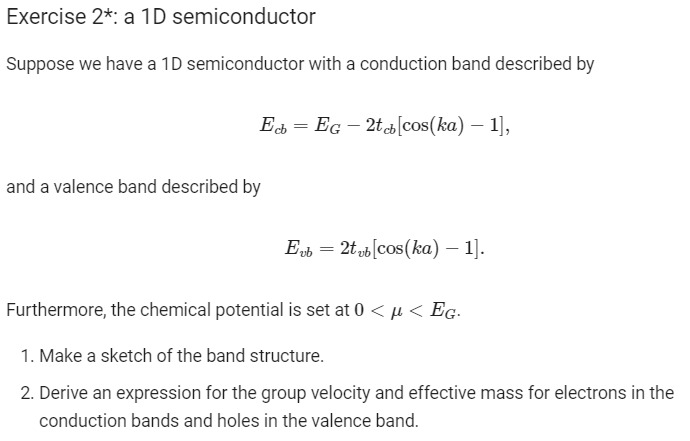
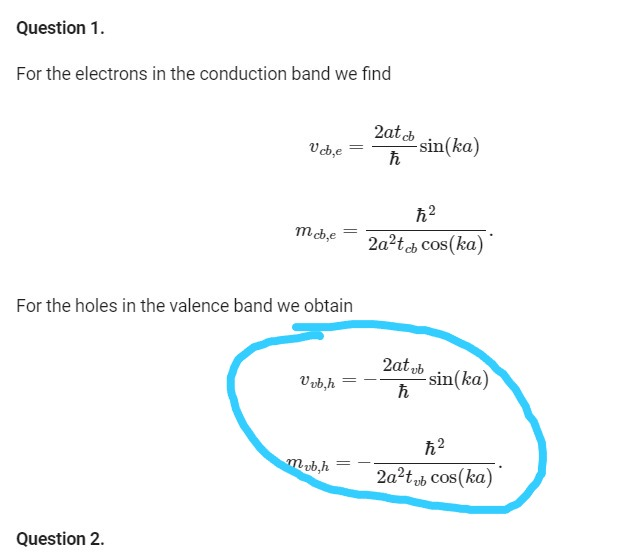
Look at the beginning of Lecture 13 in the lecture notes “Review of band structure properties”.
You see that the effective mass is the (second derivative of the energy wrt k)^-1 * (h-bar)^2.
We have E_vb above, plug it in, and the answer should roll out.
Edit: If you continue on and get to 2.4, could you send me your derivation? I get stuck on that one myself and posted my derivation in the other question, I’m unable to derive the correct answer.
To add a bit. The minus (when it is there) in the effective mass of the holes comes naturally from the curvature of the band it sits in. It is not something we add manually in an artificial way. I believe there was an exercise in which they ask you to compute the masses of electrons and holes in both valence and conduction bands, where you see that also electrons can have negative masses and holes positive ones.
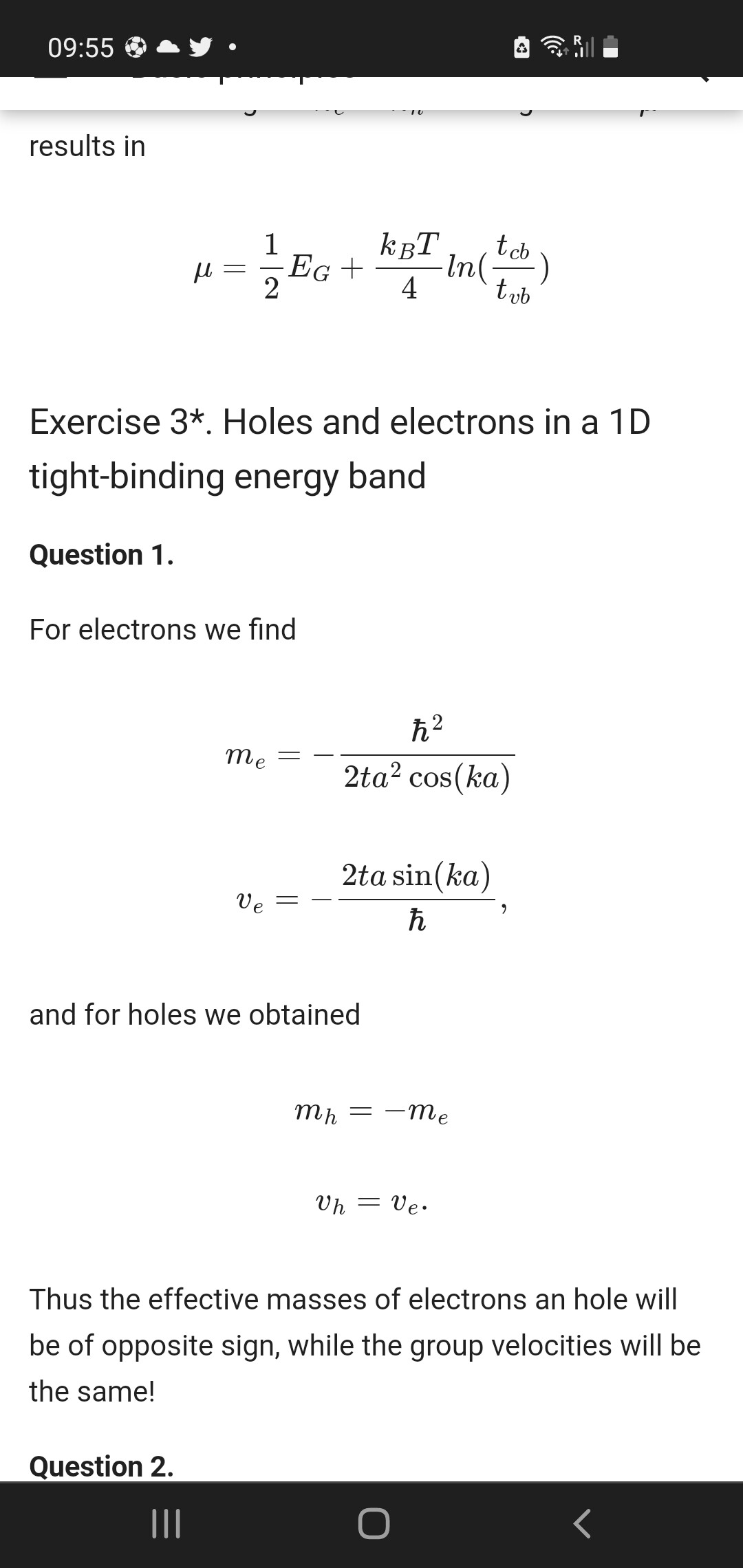
Probably because the dispersion relation is exactly the same, just opposite sign?