Good evening, I have a question about subquestion c in minitest 3. When using the reciprocal lattice vectors that we have calculated in the previous question and the location of the atoms which are written in the answer to question c, I don’t quite obtain the same result. Is it a rule that you have to calculate it using a conventional unit cell, or am I missing something once again ? In the exponents of the e functions, I always only have 1 letter (h k or l) due to the fact that the locations of the atoms are parallel to only one of the basis vectors. Thanks in advance for you response.
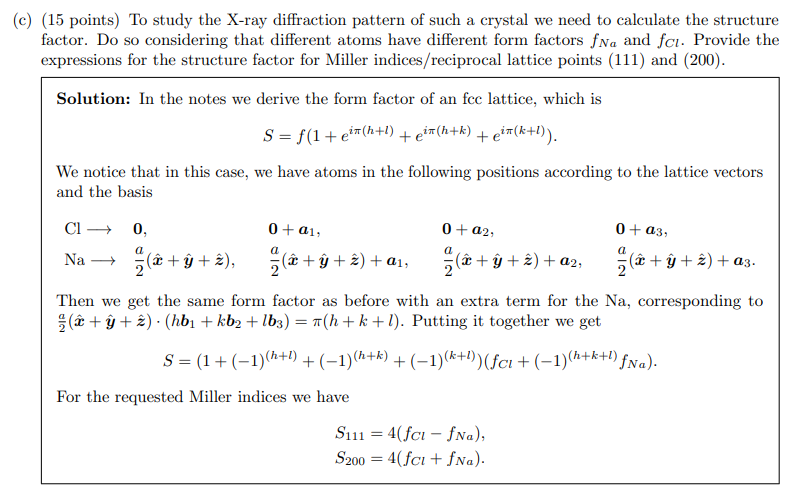
I don’t know if I exactly understand where you found trouble, but the step that is maybe missing explicitly is the multiplication
\frac{a}{2}(\hat{\boldsymbol{x}}+\hat{\boldsymbol{y}}+\hat{\boldsymbol{z}})\cdot(h\boldsymbol{b}_1+k\boldsymbol{b}_2+l\boldsymbol{b}_3)=
\frac{a}{2} [h(\hat{\boldsymbol{x}}+\hat{\boldsymbol{y}}+\hat{\boldsymbol{z}})\boldsymbol{b}_1+k(\hat{\boldsymbol{x}}+\hat{\boldsymbol{y}}+\hat{\boldsymbol{z}})\boldsymbol{b}_2+l(\hat{\boldsymbol{x}}+\hat{\boldsymbol{y}}+\hat{\boldsymbol{z}})\boldsymbol{b}_3]=
\pi[h(1,1,1)(-1,1,1)+k(1,1,1)(1,-1,1)+l(1,1,1)(1,1,-1)]=
\pi(h+k+l)
If you have done the calculation differently it is possible that you get terms like
f_{Na}(-1)^{(2h+2k+l)} which is actually the same as f_{Na}(-1)^{l} with only one miller index as you mention. However you do it, with different choices of unit cells you should end up with the same results for the two requested miller indices (there is a more general rule, but I’d say this check is already enough for what we are interested in). If you obtain a different result, then probably you missed something.
Let me know if this helps, otherwise we can discuss further 