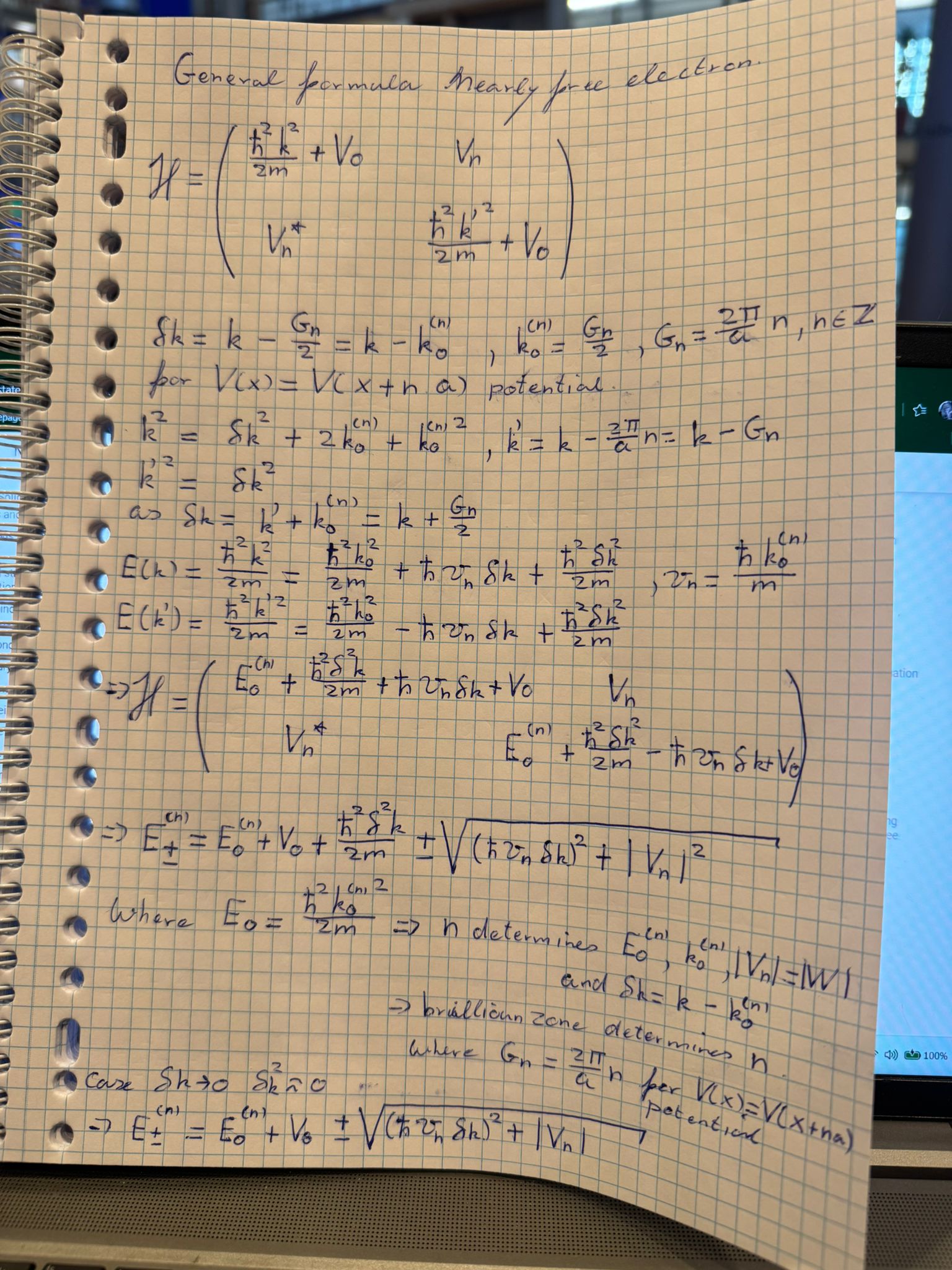
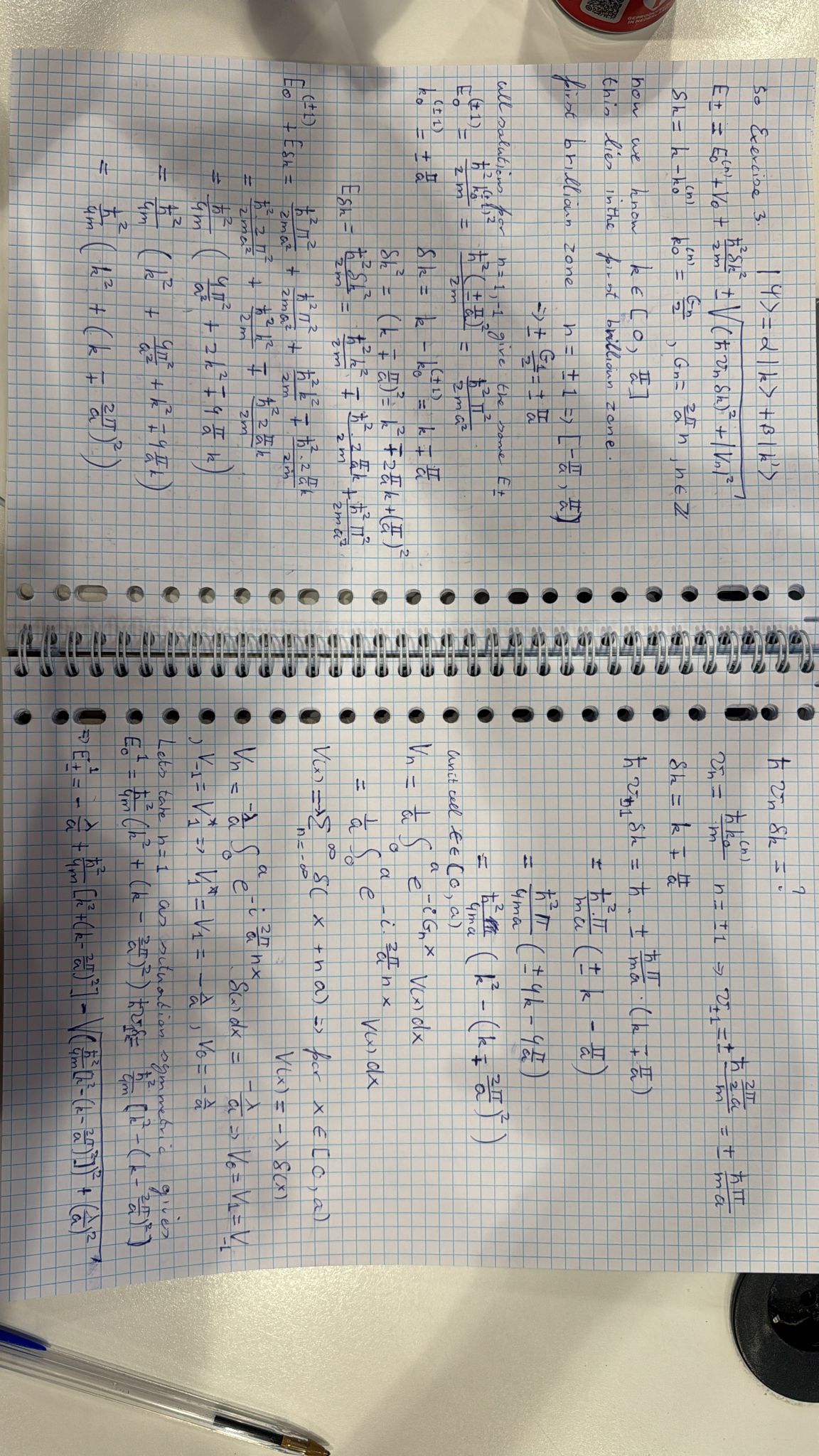
Hey I have a question. I was wondering why for exercise 3 and all the other homework exercises we don’t use similair methods discussed in the lectures and the reader. After looking a little deeper into the mathematics behind the formula derived in the reader I realized that this only counts for δk–>0 leading to a linear approximation as δk^2=0. But I tried to derive it without this approximation, leading to the general formula derived below. This formula counts for the nth brillioun-zone, and for a V(x)=V(x+na) potential. Everything is worked out in detail. After the derivation I tried it on exercise 3,leading to exactly the same dispersion relationship the solution has(see next image). Instead of using the notation they gave Ψ(x)=αψ1(x)+βψ2(x) I used ∣ψ⟩=α∣k⟩+β∣k′⟩ as I saw similarities.
Question: Is this a valid way of solving this problem and any general case of the nearly free electron? Where Gn=2pi*n/b and where b=a in this case. But for a potential V(x)=V(x+2na) it would be b=2a for example leading to a smaller brillion zone.
I noticed a mistake for my k’ squared but you wil probably recognize that this does not effect the derivation. For E(k’)
Yes, this is a valid way to solve the problem. It is essentially the same method as in the exercise, just written in ket notation instead of real-space wavefunctions. The states \psi_1(x) and \psi_2(x) are the real-space representations of |k\rangle and |k-2\pi/a\rangle.
One useful clarification: the main approximation in the lecture is not really “setting $\delta k^2=0$”. That is just a linearization used to get a simple expression close to the avoided crossing. In Exercise 3, you can keep the full quadratic free-electron dispersions and diagonalize the 2 by 2 Hamiltonian directly:
H =
\begin{pmatrix}
\varepsilon(k)+V_0 & V_n \\
V_n^* & \varepsilon(k-G_n)+V_0
\end{pmatrix}.
The more important approximation is that we keep only two plane-wave states. This is valid near a simple crossing, where those two states are close in energy and the other |k+G\rangle states are much further away. For the full band structure, or if more than two states become degenerate, you would need to include more plane waves.
So yes: for Exercise 3 your method is valid, and for a general nearly-free-electron problem it is the standard local method near a band crossing. Also yes, the period of the potential determines the reciprocal lattice: if V(x)=V(x+b), then G_n=2\pi n/b. A potential with period 2a therefore has a smaller Brillouin zone than one with period a.