I don’t see how the given potential generates the band structure we see in the solution. The potential is a Dirac delta train of 2 different alternating atoms, why does it have a band structure that would be the same for a train of 1 repeating atom? Is it because it’s the dispersion of the electron which follows from LCAO?
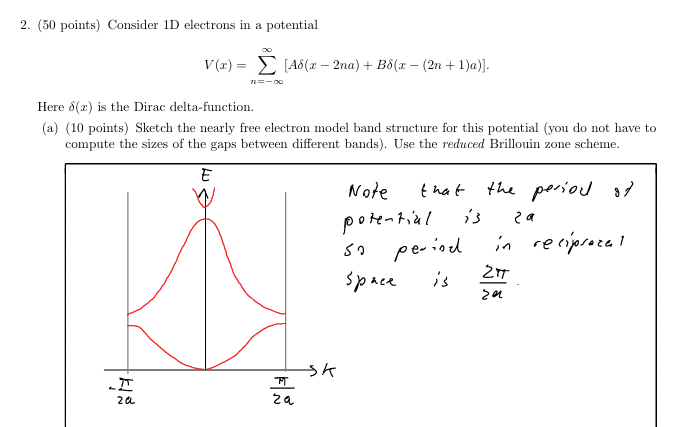
The important point is that the sketch first shows the nearly-free-electron picture before focusing on the exact gap sizes.
Because the potential has period 2a, the reciprocal lattice spacing is \pi/a, so the free-electron parabola is folded into the reduced Brillouin zone -\pi/2a < k < \pi/2a. That folding is why the overall sketch looks like the usual reduced-zone free-electron picture.
The alternating atoms enter through the Fourier components of the potential, and therefore through the gaps. For
V(x)=\sum_n [A\delta(x-2na)+B\delta(x-(2n+1)a)],
the Fourier components are proportional to
A+(-1)^mB.
So alternating atoms do matter: they change which gaps open and how large they are. It is not because of LCAO; this question is using the nearly-free-electron model.