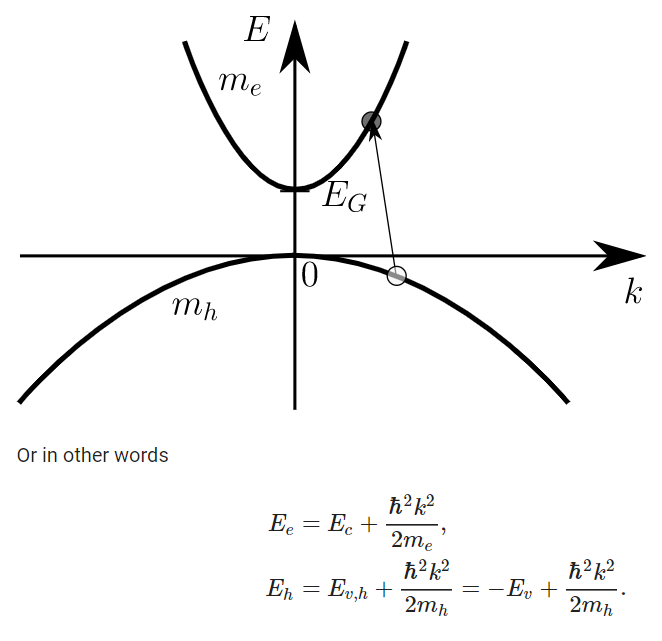
I’m trying to reason how this graph should look like when there would be no band gap, so E_{valence} = E_{conductor} = 0.
Starting point:
E_{hole} = - E_{electron}
When there is no band gap (and disregarding the zero-point energies), I’d say the energies should be the same at k=0 using E_{electron}= \frac{h^{2}k^{2}}{2m_{e}}.
Then, the electron energy should increase for increasing k. Likewise, the hole energy should decrease for increasing k.
But if that’s the case, shouldn’t the hole energy be defined as:
E_{hole} = E_{valence}-\frac{h^{2}k^{2}}{2m_{h}}
As this gives a decreasing energy for increasing k?
The solution of exercise 18.1 from the book seems to support this logic:
Then, the electron energy should increase for increasing k . Likewise, the hole energy should decrease for increasing k .
Are we talking about the valance band here? If so, then energy of an electron in the valance band would decrease with increasing k as we see in the picture above. Since, in this case, the effective mass of the valance band is negative m_{e,V}<0, we get the following dispersion for an electron:
E_{e,V} = E_V + \frac{\hbar^2 k^2}{2 m_{e,V}}
Now, with that, we can change our point of view and talk about holes. We essentially defined the energy of a hole to be negative that of an electron, so that:
E_{h,V} = -E_V + \frac{\hbar^2 k^2}{2 m_{h,V}}
where we used m_{e,V} = -m_{h,V} as well. So we see we indeed get the same expression as in the lectures.
(In the above explanation, I left the indices V to explicitly indicate which band we are considering)
Regarding the bit you reference from the book, I’m not sure why they chose to write things the way they did.