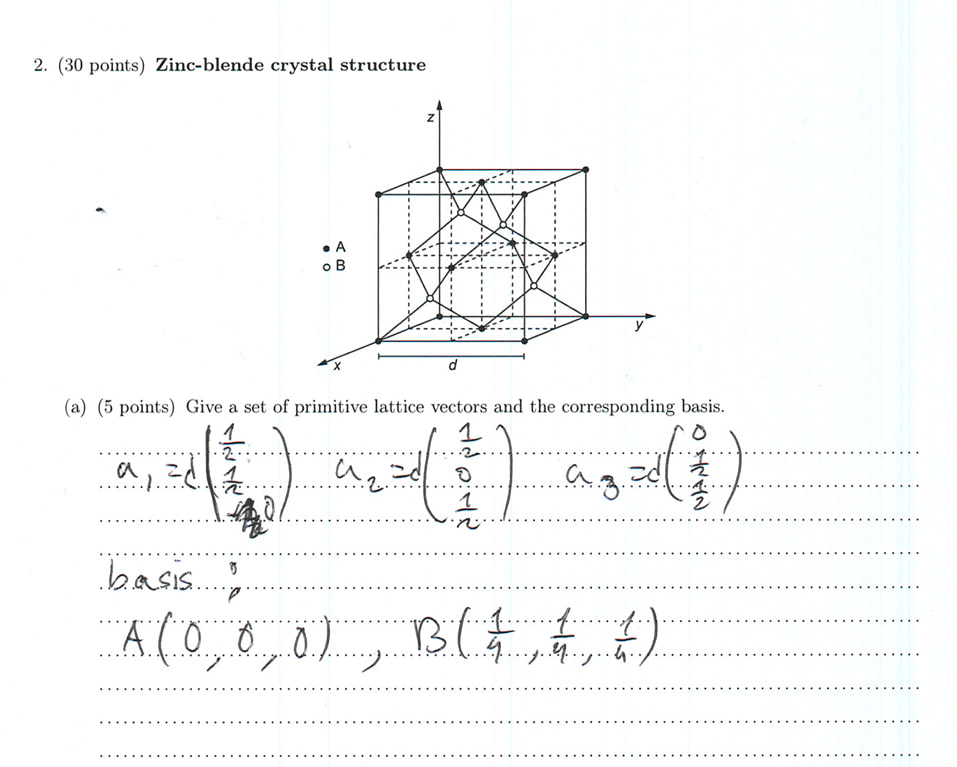
Hey I have a question about this exercise. Based on how the axis is defined we can define the primmitive unit cell as the solutions suggest. My problem with this is that it is visible in the sketch that a basis of B(1/4,1/4,1/4)=(f1,f2,f3) would say that the B atom is located at r1=(1/8d,1/8d,1/8d) as the basis vector is defined as ri=f1a1+f2a2+f3a3. Clearly in the sketch there is no B atom located at that point. Also the exercise has a predefined axis. But if I was allowed to rotate the axis 90 degrees such that my orgin is also displaced(see image) then I could use r1=(1/4d,1/4d,1/4d) and use the suggested primitive vectors I would come to a solution with a basis A(0,0,0) B(1/2,1/2,1/2) which seems like a more reasonable answer.
Question: Does this correction have a mistake, and if not what am I missing conceptually?
It looks like you’re confusing the basis of primitive lattice vectors which in this case is not orthogonal with the orthogonal xyz basis.
If we work out the equations in the xyz basis we get
Which is the location of the B atom. This looks like the same lattice as for diamond, except in diamond all the atoms are carbon atoms. You could maybe take a look at exercise 2 from the Crystal structure lecture which covers this.
@c.a.martens
But if you look at the sketch there is no B atom at that location right? Also you’re right about the maths I was wrong there thanks for the correction.
I think you’re generally allowed to define your own coordinate system.
There are two separate points here.
First, @c.a.martens’s correction is right: the coordinates in the basis are fractional coordinates with respect to the primitive lattice vectors, not coordinates along the drawn orthogonal x,y,z axes. So, for example, with
the coordinate (1/4,1/4,1/4) means
not (d/8,d/8,d/8). This is the main conceptual point.
Second, it is also perfectly fine to choose your own origin and lattice vectors, as long as the lattice vectors and basis are changed consistently. Different-looking answers can describe the same crystal.
That said, there is indeed a minor error in the example solution. With the axes as drawn and with the primitive vectors written in the solution, the B atom appears to be shifted in the opposite body-diagonal direction. So instead of
one should write
or equivalently
So your proposed coordinate system can be valid if applied consistently, but it would give the answer B(1/4, 1/4, 1/4) and not B(1/2, 1/2, 1/2).
Hi! I also have a problem with this exercise. It seems to me that if you would take the basis as defined and then ‘tile’ 3D space, all 8 cubes would contain such a structure, instead of the 4 that are drawn. So if you would take those vectors, you would miss the kind of metastructure of the crystal. How does that work?
The primitive vectors do not define 8 small axis-aligned cubes inside the drawn cube. They define skew primitive cells of the fcc lattice.
One quick way to see this is to add them:
So moving one step along each primitive vector takes you across the full body diagonal of the conventional cube, not to its center at (d/2,d/2,d/2).
The conventional cubic cell contains 4 primitive cells, not 8. The “metastructure” is not missing: it is encoded in the non-orthogonal primitive lattice vectors plus the two-atom basis. The cube in the drawing is just a convenient conventional cell for visualization.