they use n_D ~N_D, but if you use the expression for the concentration of n_D, than you’d get something like: exp(something) = 0 due to the +1 in the Fermi-D distribution. Does this mean the exponent should go to -inf so sort of equal as to saying that mu >>E_D?
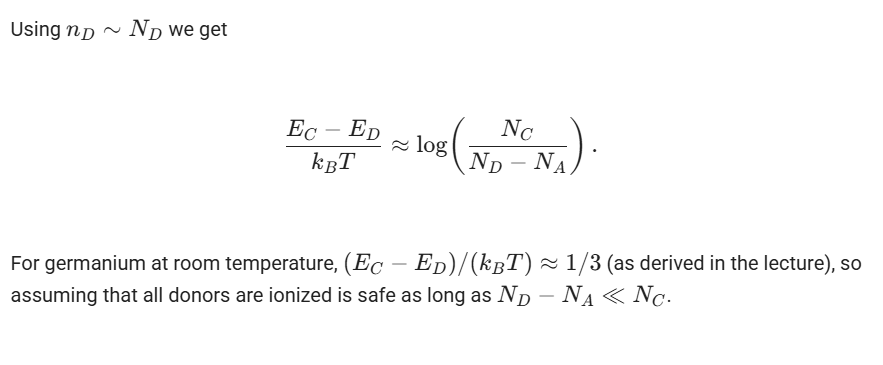
Here n_D is the concentration of donor-bound electrons, not ionized donors. So the fully ionized approximation means n_D\ll N_D, not n_D\approx N_D.
Using
n_D=\frac{N_D}{\exp[(E_D-E_F)/(k_BT)]+1},
we get n_D\ll N_D when
\exp[(E_D-E_F)/(k_BT)]\gg 1,
so E_F is well below E_D. The approximation starts to fail when E_F approaches E_D within order k_BT. It is not necessary to make the exponential literally zero.
So the sign is the opposite of \mu\gg E_D: if \mu=E_F is far above E_D, the donor level is occupied and the donors are mostly not ionized.