I followed this course last year and during that exam one question truely confused me it’s the following.
If we take the dispersion relation:
and consider the cases where t1>>t2, I assumed that we would be able to neglect the t2 term entirely, but no band gap would arise. While this should be the case, am I missing something?
And we’re interested in t_1 \gg t_2. Let’s see what this gives. First, if t_2 = 0, then we’re looking at 2 bands. One with \varepsilon = \varepsilon_0 and another with \varepsilon = \varepsilon_0 - 2t_1 \cos(ka). These bands always have a large separation in energy \sim t_1 except at the point where \cos(ka) = 0 (k = \pm \pi/2a), where these two simpler dispersion relations cross at \varepsilon = \varepsilon_0. This is, once again if we neglect t_2 completely. However if we do remember that t_2 is finite, we get the energies of the two bands equal to \varepsilon_0 \pm t_2 at the point where two bands are the closest to each other.
I have a follow-up question to this answer. How does that show you that you should get two cosine bands in the end? I understand that we can’t simply neglect t_2 because t_1 is multiplied by a cosine so it’s not always dominating the t_2 term. A few questions:
But how does this result in two cosine bands eventually?
From your reasoning I understand that the bands are supposed to cross at some point but this crossing is avoided because of the lattice potential right?
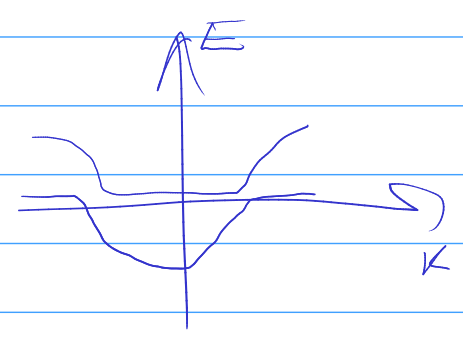
Even with this explanation I do not really see why the centre of the top band becomes smeared out to a constant. How can I derive this smearing out of the top cosine band? (is there a taylor expansion underneath all this that I’m missing?)
The two bands aren’t both cosine: one is cosine, another one is constant. We get the overall band profile by setting t_2=0.
Yep, exactly.
I’m not sure what you mean here. If we neglect t_2, we get a cosine band and a band with constant energy intersecting the cosine band halfway. Because of the crossing, both the lower and the upper band become cosine in half of the Brillouin zone and roughly constant in another half, something like this: