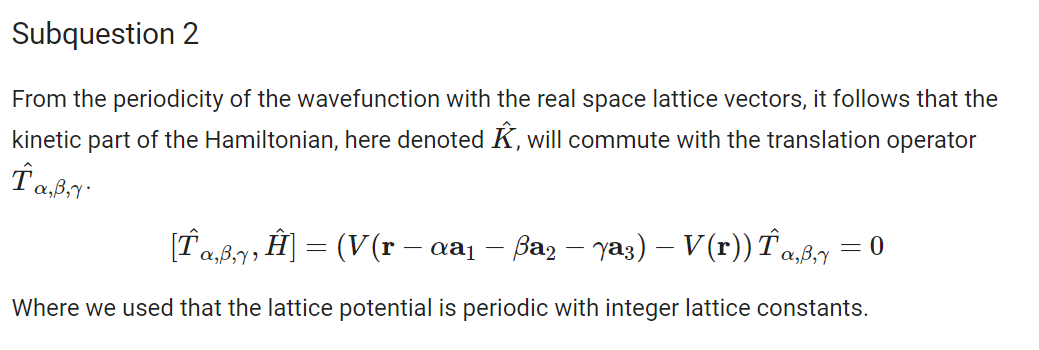
I have 2 questions/comments on this answer model.
- can you please elaborate on why K commutes with the hamiltonian operator? I can’t see how this follows from periodicty
- if we only consider commutation of the potential, how do i get
 ?
?
did we use  ? Does this also act on the potential. And if it does, shouldn’t the brackets be left out?
To answer both questions take:
[T,H]\Psi = (TH-HT) \Psi where H=K-V.
If we use T as an operator that shifts space coordinates and recall that K corresponds to a derivative in real space, we realize that the kinetic terms disappear due to periodicity: T\Psi=\Psi and T(K\Psi)=K\Psi. This is more or less saying “if the system is periodic, it makes sense that wavefunctions are periodic and therefore their velocities as well”.
About the second question, you are right about T\Psi, but I do not understand what you mean by “shouldn’t the brackets be left out?”
I see where you’re going now, never mind the brackets! Thanks a lot!
Why are the brackets around both V(r - \alpha a_1 - \beta a_2 - \gamma a_3) and V(r) ?
The first element has already been multiplied by T_{\alpha,\beta,\gamma} right?
It now looks like this is happening: (T_{\alpha,\beta,\gamma}V(r)-V(r))T_{\alpha,\beta,\gamma}
Yeah Maurits I am pretty sure the brackets should be ignored