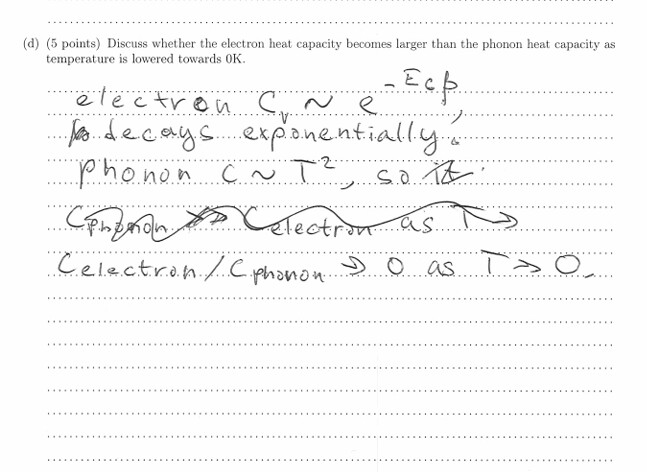
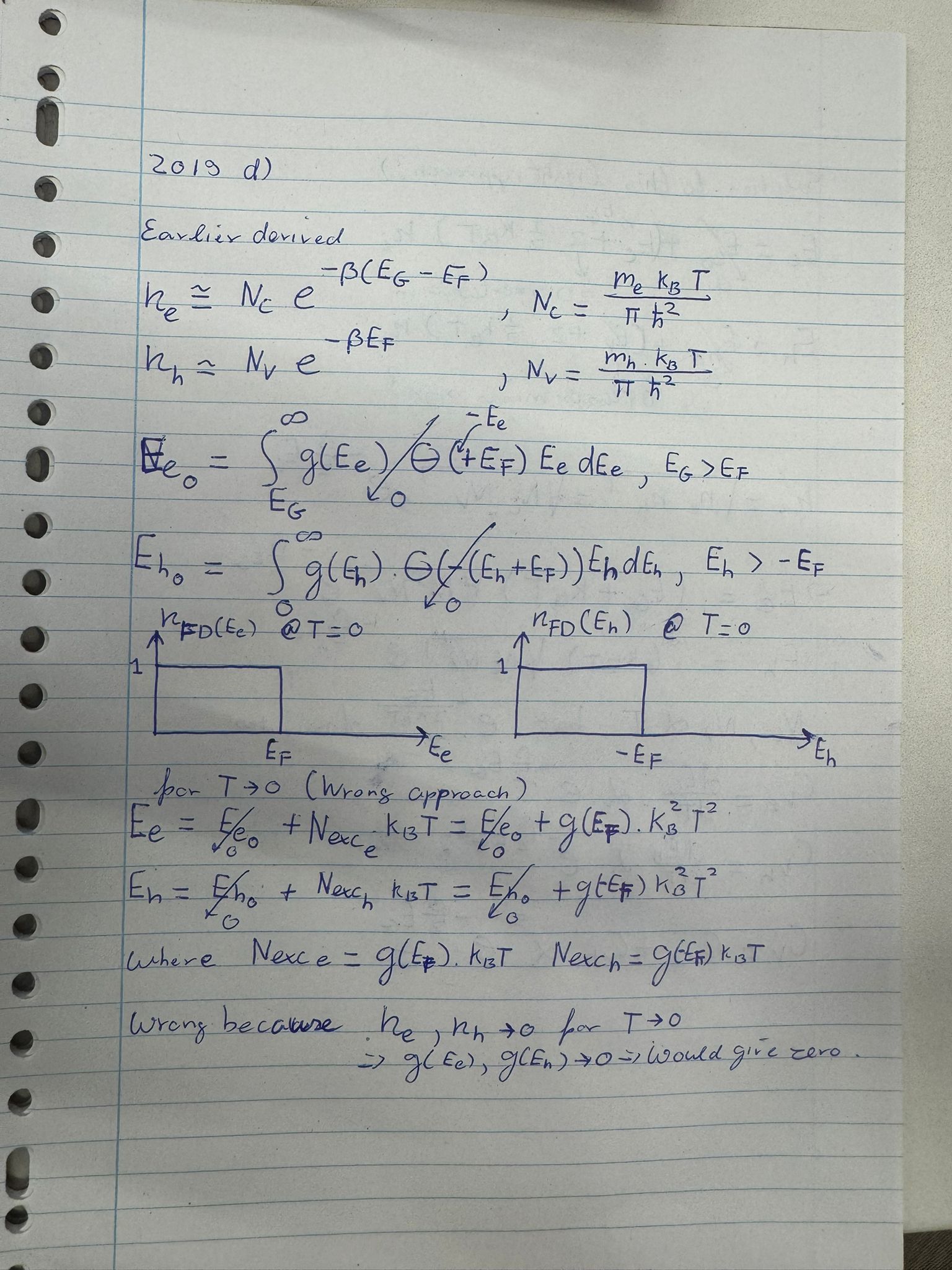
Question:Why can’t I use the same approach as the free electron model in a semiconductor? I think I know the answer because at T–>0 your electron density in the conduction bend goes to zero due to the fermi dirac distribution approaching a step function,idem for the holes. Resulting in a heat capacity that is zero. (See second image)
My solution: I came up with a equation using the law of mass action for a intrinsic semiconductor. (See last image)
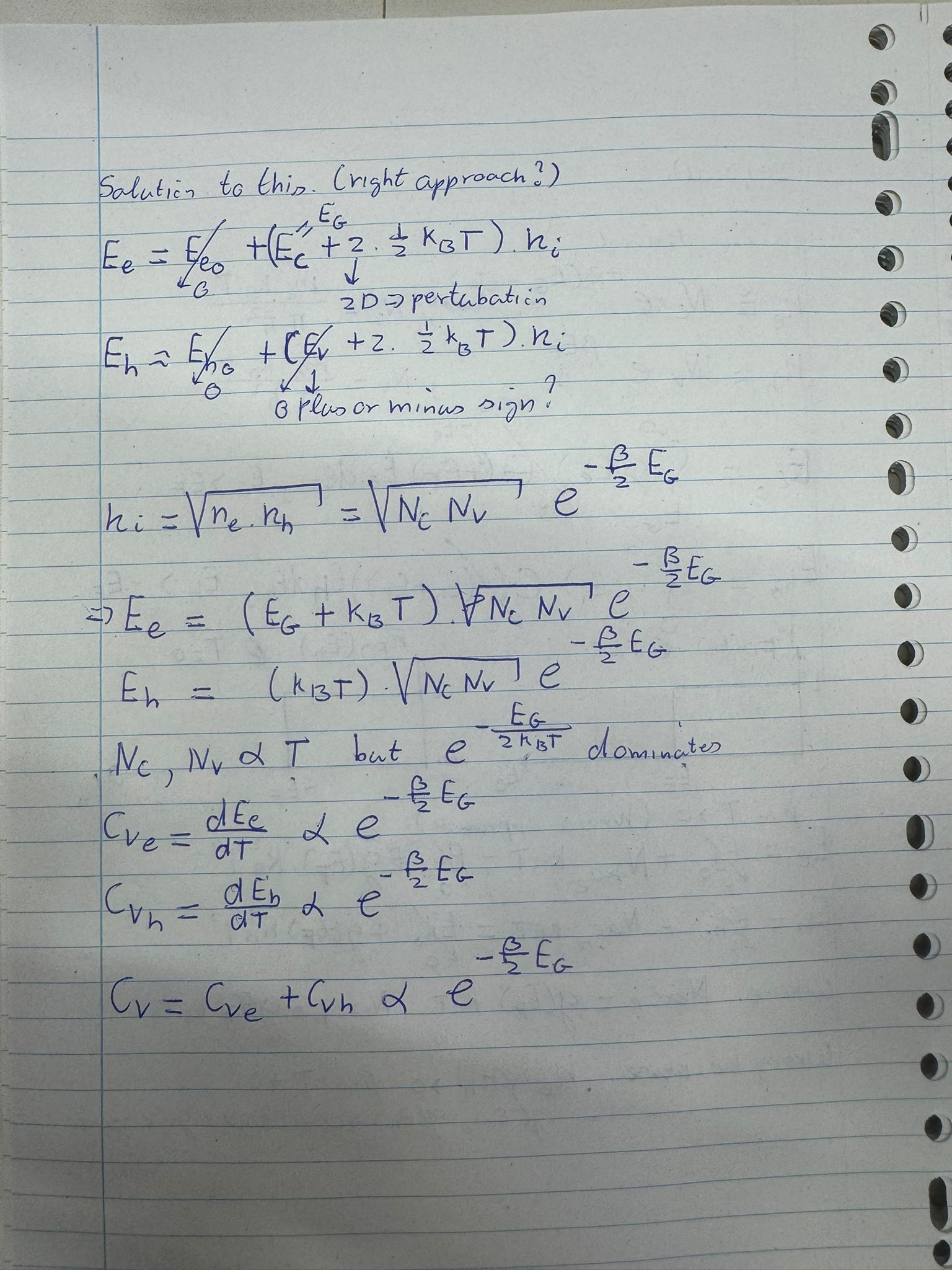
Note ni=ne=nh this is only possible because we are given that we have an intrinsic regime
The difference with the free-electron calculation is that there the Fermi level lies inside a band, so there is already a finite density of electrons at T=0. Then only the electrons within an energy range \sim k_BT around E_F are thermally excited, giving the usual electronic heat capacity proportional to T.
For an intrinsic semiconductor the Fermi level lies in the gap. At T=0 there are no electrons in the conduction band and no holes in the valence band. The number of carriers is thermally activated:
n_e=n_h=n_i \propto e^{-E_G/(2k_BT)}
(up to powers of T from N_C and N_V).
So your mass-action approach is the right way to think about the carrier density. The key conclusion is that the exponential factor dominates as T\to 0. Therefore the electronic heat capacity of the semiconductor is exponentially suppressed, while the phonon heat capacity only goes as a power law, here C_\mathrm{ph}\propto T^2 for a 2D phonon system.
So the electron heat capacity does not become larger than the phonon heat capacity when lowering T toward zero.
Thank you but I still question my calculation itself. Is it that I can approximate my electron energy at T—>0 as Ee=Ee0 +ni(Ec+2*KbT) for a 2D semiconductor?Because I could not find this anywhere in the reader.
Yes, that estimate is reasonable, but the factor depends on what energy you are counting.
For a 2D parabolic band the density of states is constant. In the Boltzmann limit, the average kinetic energy above the band edge is therefore
\langle E-E_C\rangle = k_BT.
So for conduction electrons,
E_e \approx n_i(E_C+k_BT).
For an electron-hole pair, you get one such kinetic contribution from the electron and one from the hole, so the excitation energy is roughly
E_G+2k_BT.
This formula is not written directly in the lecture notes but it follows from the constant 2D density of states plus the Boltzmann approximation. It is also very intuitive: to create an electron-hole pair we need to give a single electron energy of E_G and also have 2k_BT as a thermal energy of two resulting excitations. The main scaling of the energy still comes from the total number of excited particles, which is
n_i\propto e^{-E_G/(2k_BT)}.