Hi!
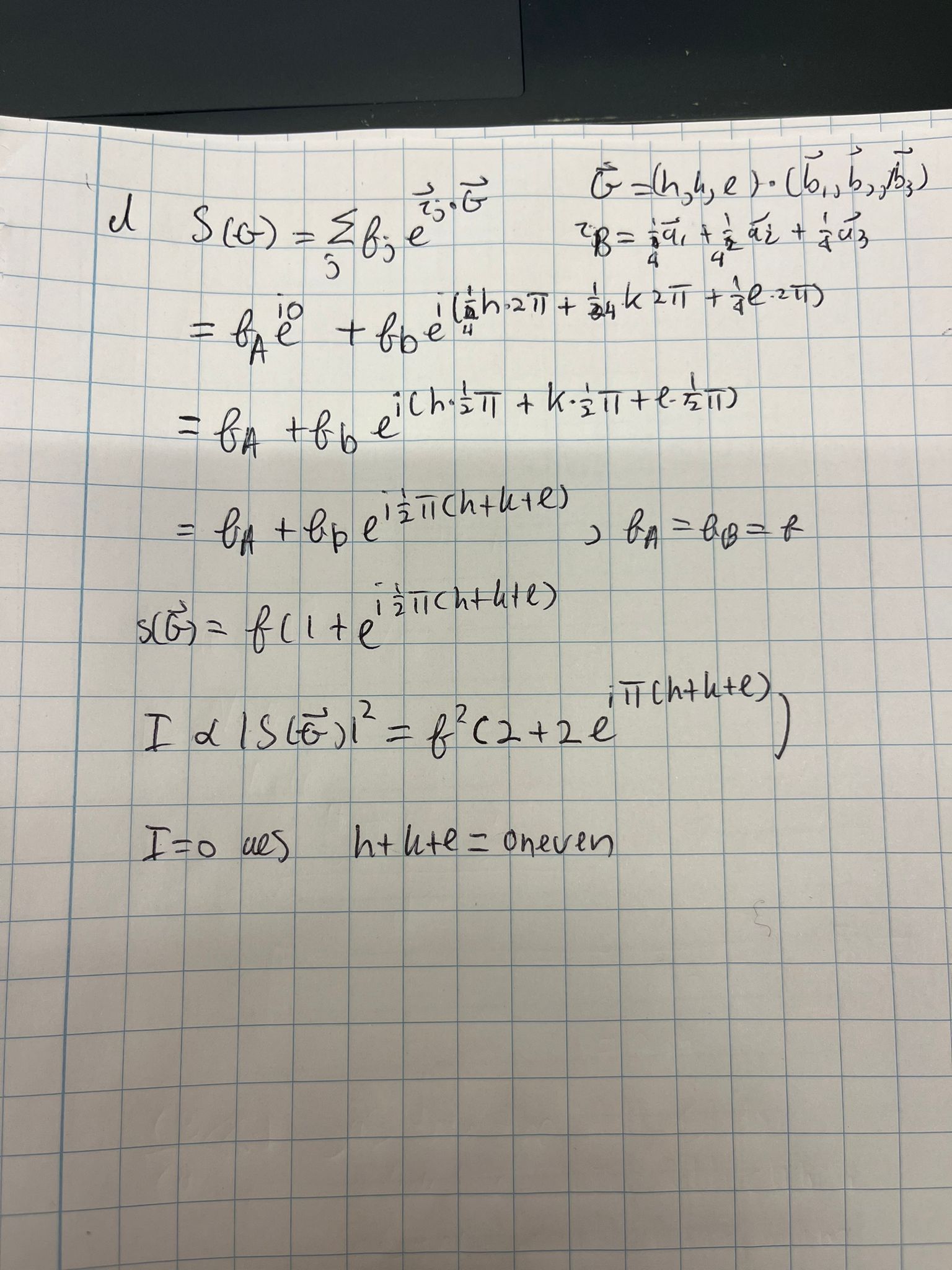
I had a question regarding the answer. It asks when the diffraction peaks disappear and computes this straight from the form factor. However I tought that the peaks are peaks in intensity, and intensity varies with |S(G)|^2, thus you would have to first take the modulus squared and then look at for what h,k,l the peaks would disappear. In that case it would be for h+k+l = uneven. See picture. Is my line of thinking correct?
thanks
You are right to consider that measured intensity is proportional to |S(\mathbf G)|^2. But a peak disappears only when
|S(\mathbf G)|^2=0,
which is equivalent to S(\mathbf G)=0. So it is fine to look for zeros of the structure factor directly.
For the two-atom basis with displacement (a/4,a/4,a/4),
S(\mathbf G)=f\left(1+e^{i\pi(h+k+l)/2}\right).
Taking the modulus squared gives
|S(\mathbf G)|^2
= f^2\left(1+e^{i\phi}\right)\left(1+e^{-i\phi}\right)
=2f^2(1+\cos\phi),
\quad
\phi=\frac{\pi}{2}(h+k+l).
This vanishes when \cos\phi=-1, so when h+k+l=4m+2. For odd h+k+l, the phase is \pm i, and the intensity is not zero.
So the line of thinking is right, but the modulus squared needs the complex conjugate.